Culture Is Not a Post-Close Problem: What M&A Leaders Need to Examine Before the Deal
A merger does not create every cultural problem it encounters. More often, it places existing fractures under enough pressure to become visible—and expensive.
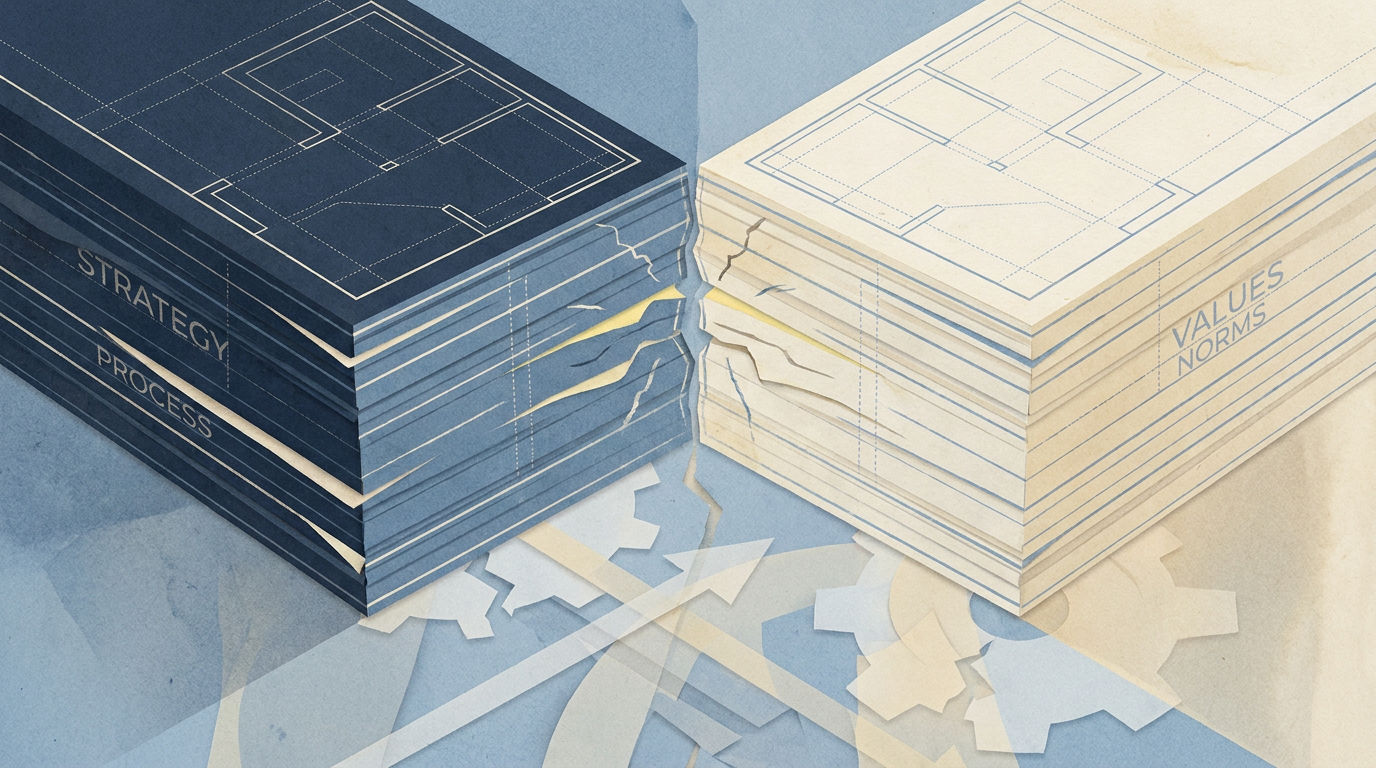
I once sat in a post-merger integration meeting where the slide deck was flawless. Synergies mapped. Timelines color-coded. Headcount rationalized down to the decimal. It was a beautiful piece of work.
Then someone asked a very simple question: “Who is actually in charge of decisions right now?”
Silence. Not the thoughtful kind. The uh-oh kind.
Finally, an executive cleared his throat and said, “We’re aligned at the top.” In my experience, that is executive shorthand for No one knows, everyone is nervous, and please do not ask that again.
This company had spent millions examining the transaction, yet no one in the room could explain who was allowed to decide, speak, or disagree. The synergies were aligned. The people were already in triage.
“M&A often fosters us-versus-them thinking.”
— Jennifer J. Fondrevay, founder of the M&A consultancy Day1 Ready, former Fortune 500 C-suite executive, and veteran of three multibillion-dollar acquisitions
That is how the human part of a deal begins to unravel. Decisions that once took a day require four approvals. Leaders on each side privately question the competence of the other. Employees identify themselves by legacy company, usually right before explaining why the other group does something incorrectly. Key people begin to leave, although the knowledge generally starts exiting before the resignation letters do.
None of this appears in the celebratory photograph. It does, however, appear eventually in delayed milestones, duplicated work, customer disruption, turnover, and unrealized value.
The human part of the deal has already started
I am not arguing against financial, legal, operational, or market diligence. That would be absurd, and possibly career-limiting. I am arguing that the work is incomplete when the deal thesis depends on people sharing knowledge, trusting new leaders, making decisions together, or accepting a new identity. In most transactions, at least one of those very human things is doing a great deal of unacknowledged work in the model.
Culture is often assigned to a post-close workstream, as though it were an internal communications exercise that can begin after the serious people finish with the spreadsheets. By then, leaders may already have made critical assumptions about who will stay, how quickly teams will integrate, and whether the organizations can actually operate as one.
Cultural due diligence brings those assumptions into the deal conversation earlier. It does not ask whether both companies managed to place integrity on a values page. Nearly everyone has integrity up there somewhere, nestled between excellence and collaboration. Cultural diligence examines how work actually gets done, how power moves, what people fear, and which behaviors the system rewards.
The values page will not tell you how the place works
Every organization has a formal culture and an informal one. The formal culture lives in policies, presentations, org charts, and leadership statements. The informal culture lives in the answers to more revealing questions:
Who can disagree with the CEO and remain influential?
How are bad news and missed targets handled?
Which decisions require an unofficial conversation before the official meeting?
Who holds power that the org chart does not explain?
What behavior is tolerated because the person producing it is considered indispensable?
Integration risk lives in the gap between the formal culture and the real one. Two companies may both claim to value collaboration while meaning entirely different things. In one, people debate openly and then decide. In the other, consensus is built privately so no one is surprised in public. Neither approach is inherently wrong. Pretending they are the same is how “quick alignment” becomes a recurring ninety-minute meeting.
Award-winning New York Times bestselling author and journalist Daniel Coyle, who studied high-performing groups for The Culture Code, makes the point plainly: strong culture is not built from nice-sounding value statements. It is built through repeated signals of safety, shared vulnerability, and purpose. During an integration, employees study those signals obsessively. They notice whose history is honored, whose process survives, and whose voice suddenly matters less.
A deal puts existing cracks under pressure
A transaction intensifies uncertainty, status concerns, workload, and identity threat. Under that pressure, small cultural weaknesses become operational problems. Siloed decisions become duplicated systems. Low trust becomes knowledge withholding. Disengaged middle managers become stalled integration. An overreliance on informal power brokers becomes confusion about who can actually authorize change.
I began studying cultural due diligence because I had watched too many promising deals go sideways for reasons everyone later described as “people issues.” That phrase is doing a heroic amount of work. Research on post-acquisition integration keeps returning to trust, cultural fit, and the human effort required to share knowledge and implement change. My conclusion is blunt: the merger may not have created the dysfunction. It simply removed the organization’s ability to keep compensating for it.
Fondrevay reached that conclusion after interviewing executives across organizations and deal roles. Mergers readily produce an “us versus them” split. The language may sound minor, but it reorganizes loyalty, trust, and information flow. People begin protecting the legacy organization at precisely the moment the deal requires them to build something shared.
This is also why turnover is a lagging indicator, not the first sign of trouble. Long before a resignation appears in a dashboard, people go quiet. They stop volunteering ideas, narrow their effort, and begin quietly testing the market. The human withdrawal comes first. The visible financial cost arrives later, wearing a name badge that says unexpected attrition.
“Great cultures don’t happen by chance.”
— Daniel Coyle
Questions worth asking before the ink dries
Good cultural diligence is not a vibe check and it is not a values survey with nicer graphics. It requires people who can read both business systems and human behavior. At minimum, I want answers to these questions:
How are decisions supposed to be made, and how are they actually made?
Can someone challenge a leader, raise a risk, or admit an error without paying a political price?
Are middle managers engaged translators of strategy, or exhausted buffers holding a fragile system together?
Who carries the institutional knowledge, customer trust, and social credibility, regardless of title?
What happens when a target is missed, a customer is angry, or two executives disagree?
Do the organizations respect what the other side knows, or does each quietly assume it is acquiring the adults in the room?
These findings should not sit in a culture appendix that no one reads, quietly waiting to become evidence in a future lessons-learned session. They should inform valuation assumptions, retention priorities, integration governance, leadership selection, communications, and the pace of change.
Synergy needs somewhere to live
Synergy is not a line item that materializes because the model says it should. Excel is powerful, but it has yet to make two leadership teams trust each other. Synergy is an outcome produced by thousands of human interactions: information shared, decisions made, conflict handled, expertise respected, and trust earned.
My work in cultural due diligence returns to a simple principle: you get what you inspect, not what you expect. If the deal depends on collaboration, find out whether candor is safe. If it depends on retaining expertise, locate the expertise and influence before the people carrying it leave. If it depends on speed, understand the unofficial decision pathways that can move integration forward or quietly choke it.
Culture is not the soft side of the deal. It is the operating environment in which every promised benefit must survive.